
Current Fusion Landscape in the MENA Region
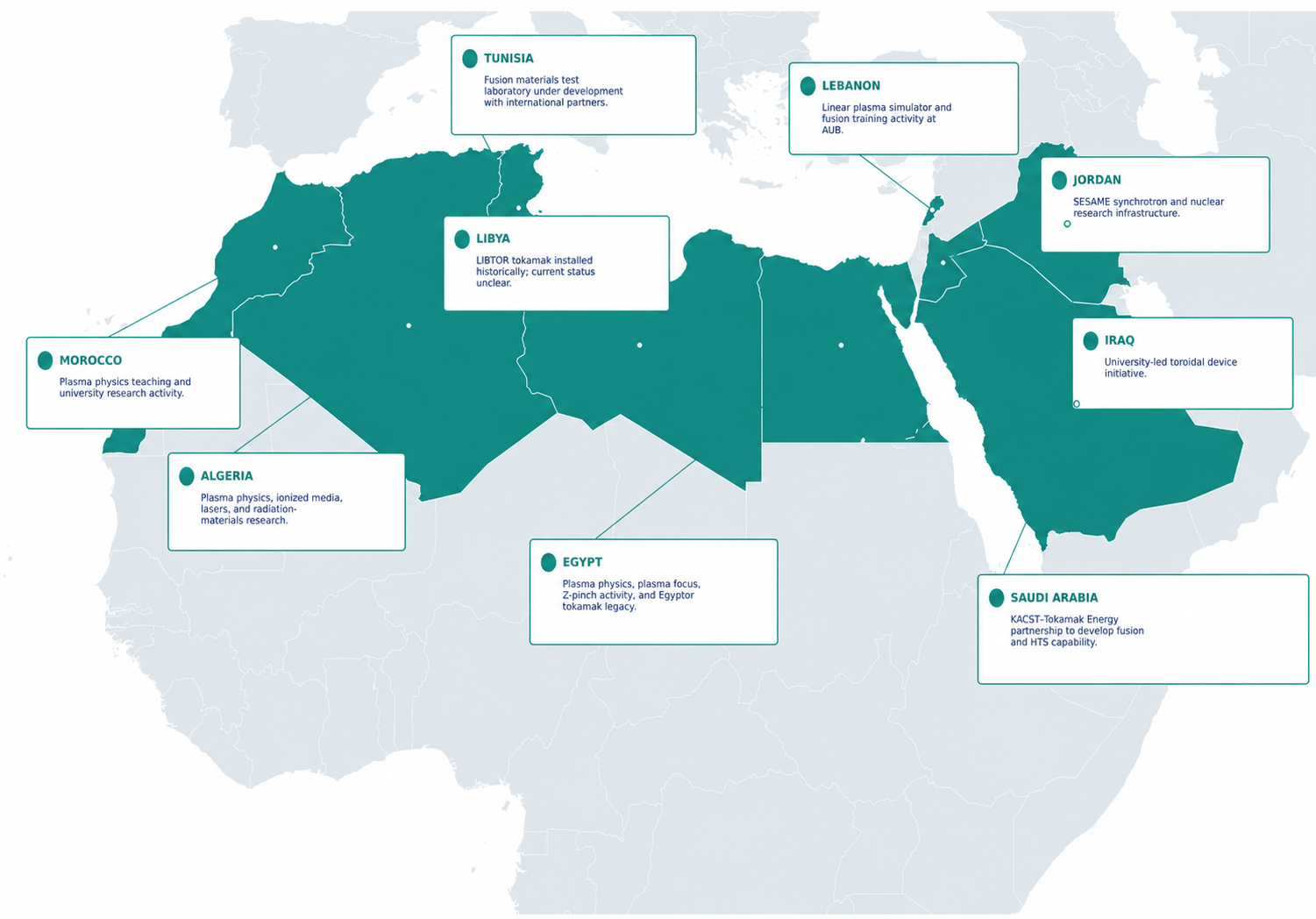
Across the MENA Region, fusion related research is developing through a mixture of university laboratories, academic programmes and early collaborations with international institutions. Although the region is not yet involved in the construction of fusion power plants, many of the scientific and engineering capabilities required for future participation already exist. These include work in plasma generation, vacuum systems, diagnostics, materials under extreme conditions, superconducting technologies and computational modelling. Much of this activity is distributed across North Africa and the Levant, led by established research groups and dedicated individual scientists.
Several Arab countries maintain fusion-relevant experiments or facilities that support training and basic research. These include non-operational tokamaks in Libya and Egypt, a linear plasma device in Lebanon and a number of Z pinch, glow discharge and radio frequency plasma units in Algeria, Tunisia, Egypt and Jordan. A growing number of universities offer plasma physics courses or postgraduate programmes, and research output continues in areas such as plasma modelling, material interaction and radiation sciences. While these activities are often independent of one another, together they show that the region has a solid technical base from which a coordinated fusion effort could be developed.
The main challenge is the absence of a regional structure that brings these capabilities together under a shared vision for fusion energy. A coordinated programme with stable funding, clear priorities and international partnerships would allow the Arab world to shift from scattered research towards planned capability development. As global progress toward fusion demonstration plants accelerates, the region now has an opportunity to define its role in the emerging fusion sector.
To receive the full report on the current fusion landscape in the Middle East and North Africa, including country profiles, capability assessments and strategic recommendations, please contact us.