
What is Fusion Energy?
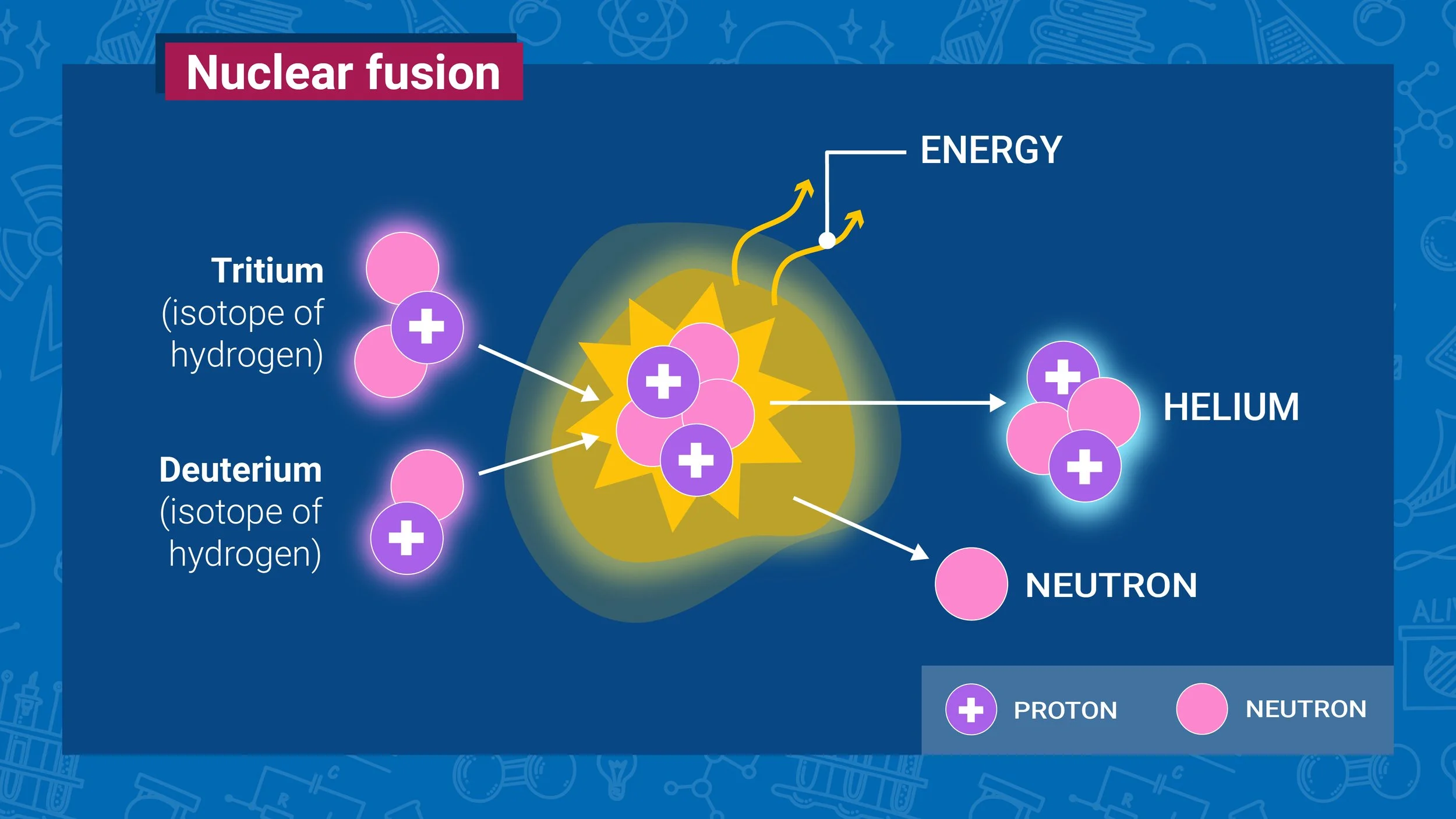
Fusion reaction process with deuterium and tritium as fuel sources. Source: International Atomic Energy Agency
Fusion energy is the process that powers the Sun and the stars. It occurs when two light atomic nuclei combine to form a heavier nucleus, releasing a large amount of energy. The aim of fusion research is to recreate this process on Earth in a controlled and efficient way. If successful, fusion could provide a safe, clean and essentially unlimited source of energy for the world.
Fusion is different from nuclear fission, which is the method used in today’s power reactors. Fission splits heavy atoms such as uranium, while fusion brings light atoms together. This difference has important consequences. Fusion does not release greenhouse gases during operation, produces far less long lived radioactive waste and carries no risk of runaway chain reactions.
How Fusion Works
At extremely high temperatures, matter becomes a plasma, which is a very hot and electrically charged state of matter. In this environment, light nuclei can collide with enough force to merge. The most accessible reaction for future power plants uses two forms of hydrogen called deuterium and tritium. When these combine, they form helium and a fast neutron, releasing a significant amount of energy.
Maintaining the conditions needed for fusion requires advanced systems for heating and containing plasma. Two main approaches dominate current research. Magnetic confinement uses very strong magnetic fields to hold the plasma away from material surfaces. The most developed device in this category is the tokamak, which has a circular, doughnut shaped structure. The stellarator is another magnetic device that can operate in a steady state and has seen major progress as computational design tools have improved. A second approach, called inertial confinement, uses intense laser or particle beams to compress small fuel targets for very short periods.
Historical Development
Serious scientific efforts to achieve controlled fusion began in the early nineteen fifties. A major turning point came at the nineteen fifty eight United Nations Conference on the Peaceful Uses of Atomic Energy, which encouraged international cooperation. Over time, many concepts were tested, including pinch devices, mirror machines, field reversed configurations and concepts involving rapid compression. Each provided valuable knowledge, but the tokamak eventually became the leading design because of its strong performance.
Since the nineteen sixties, hundreds of fusion experiments have been built in the United States, Europe, Asia and other regions. This global effort led to the creation of ITER, the largest fusion experiment ever attempted, which is now being constructed in France. ITER is designed to produce more energy from fusion reactions than the energy used to heat its plasma, an essential step toward future commercial power plants.
In recent years, private companies have become increasingly active in fusion research. Many of these companies are based in the United States, the United Kingdom and China. They are exploring a variety of new designs and are supported by advances in superconducting magnets, improved materials and powerful computing tools. Several companies plan to build pilot fusion plants during the twenty thirties.
Fusion Fuel Cycles
Most fusion research today concentrates on the deuterium and tritium fuel cycle because it requires the lowest temperature to achieve strong fusion reactions. However, this reaction produces energetic neutrons that place demanding conditions on reactor structures and require the production and handling of tritium.
In the longer term, researchers hope to develop advanced fuel cycles, such as deuterium with helium three or proton with boron eleven. These reactions produce far fewer neutrons, which would simplify engineering challenges and reduce stress on materials. These fuels require much higher temperatures, but they remain an important long term goal.
Remaining Challenges
Although rapid progress has been made, several challenges must be solved before commercial fusion power becomes possible. These include keeping the plasma stable for long periods, developing materials that can withstand high heat and neutron loads, managing the production and use of tritium and integrating all systems into a complete and reliable power plant.
Many experts agree that an intermediate scale facility is required to bridge the gap between today’s experiments and the first commercial plant. This next stage will test long duration operation, high performance breeding blankets, advanced maintenance systems and the complete fuel cycle.
A Multidisciplinary Effort
Fusion research combines a wide range of scientific and engineering disciplines. Plasma physics, nuclear engineering, materials science, mechanical and electrical engineering, advanced computing, robotics and precision manufacturing all play essential roles. Progress in fusion often leads to advances in other fields such as space propulsion, astrophysics, radiation science and industrial robotics.
This broad involvement allows many countries and industries to participate meaningfully and to contribute to the growing fusion economy.
The Future of Fusion Energy
Interest in fusion energy is now higher than at any time in its history. Advances in research, strong global cooperation and increased public and private investment have accelerated development. Many national programs expect the construction of prototype fusion plants in the twenty thirties, followed by commercial systems around the middle of the century.
Continued investment, coordinated international programs and focused research on materials, plasma control, tritium management and plant design will be essential. If these efforts succeed, fusion could provide a large scale, sustainable and environmentally responsible source of energy for the world.